Nobody wants to do a trust fall.
They never did. But for a long time, the corporate event industry kept selling them anyway—dressed up in different packaging, rebranded every few years, moved from a ropes course to an escape room to a cooking class. The activity changed. The underlying logic didn't.
Get a group of coworkers in a room, manufacture some low-stakes adversity, and call the result "connection."
It doesn't work. And after a few years of distributed teams, hybrid work, and a workforce that's increasingly allergic to anything that feels performative, companies are finally admitting it.
The team-building era isn't ending. It's already over.
What "Team Building" Actually Was
At its peak, the corporate team-building industry was worth billions. It produced a sprawling ecosystem of facilitators, activity vendors, and event formats all built around the same premise: that connection is a product you can purchase by the half-day.
The appeal was real. Leaders genuinely wanted their teams to work better together. HR needed a defensible line item. And the industry delivered something that looked like a solution—structured, schedulable, and easy to measure in post-event survey scores.
The problem was never the intent. It was the model.
Manufactured vulnerability isn't vulnerability. Supervised fun isn't culture. And a team that completes a scavenger hunt together hasn't actually learned anything about how to navigate conflict, build trust under pressure, or show up for each other when the work gets hard.
The activities were a proxy for something real. And proxies, eventually, get exposed.
The Shift That's Actually Happening
What's replacing team building isn't a new activity. It's a different philosophy entirely.
The companies getting this right have stopped asking "what should we do together?" and started asking "what do we need to solve together?" The event isn't the point. The work is the point. The event is just the environment that makes the work possible.
This shows up in a few concrete ways.
Leadership teams are replacing quarterly all-hands with smaller, higher-intensity working sessions—not to present updates, but to make actual decisions in the same room. Product teams are flying in for three-day build sprints, not to bond, but to do the kind of creative collision that async tools simply can't replicate. Sales organizations are using incentive trips not just as reward mechanisms, but as the one moment in the year where culture gets set in person and the next twelve months get framed.
The common thread isn't the format. It's the intentionality. Every one of these events has a real objective that exists independently of "team building." The connection that happens is a byproduct of doing meaningful work together—not the manufactured output of a facilitated exercise.
That's a fundamentally different product than what the industry has been selling.
Why This Matters Now
The timing isn't coincidental.
Remote and hybrid work didn't kill team building. It just made the hollowness of the old model impossible to ignore. When in-person time became genuinely scarce and genuinely expensive—in travel costs, in lost productivity, in the coordination overhead of getting distributed teams in the same place—companies started asking harder questions about what they were actually getting for it.
A trust fall doesn't survive that scrutiny. A working session that produces a real strategic output does.
There's also a generational dimension here that the industry is slow to reckon with. The workforce cohorts now making up the bulk of most companies' headcount don't want to be managed into connection. They're deeply skeptical of anything that feels like performance. They'll disengage from a forced fun exercise faster than any generation before them—and they'll tell you exactly why on their way out.
What they respond to is authenticity and purpose. An event that says "we brought you here because this work matters and you matter to it" lands completely differently than one that says "we brought you here to do a cooking class so you'll like each other more."
One respects them. The other doesn't.
What the New Model Looks Like
The events that are actually working right now share a few characteristics that have nothing to do with the activity on the agenda.
They have a real problem at the center. Not a fake one invented by a facilitator, but an actual strategic or operational challenge the team needs to work through. The event is the container; the problem is the reason to be there.
They're designed around the specific team, not a generic format. A leadership team rebuilding trust after a difficult quarter needs a completely different environment than a sales team being celebrated after a record year. The space, the pacing, the agenda structure, the mix of structured time and unstructured time—all of it should be in service of what that specific group of people actually needs.
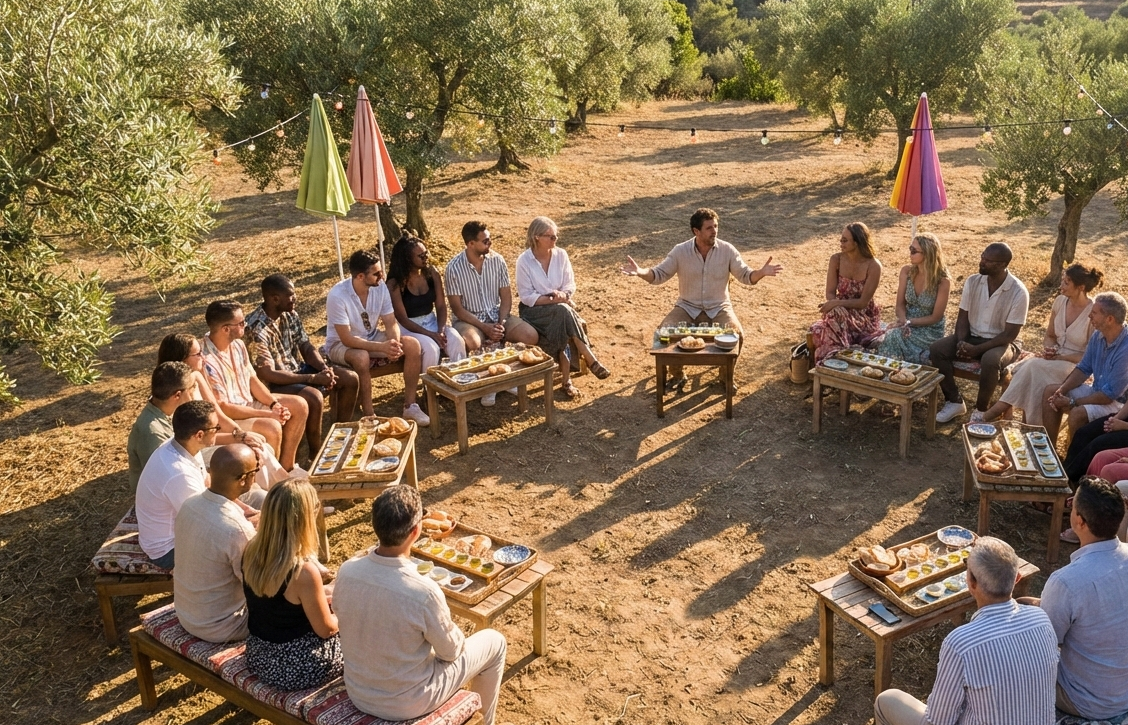
And they leave room for the unscheduled moments. The best thing that happens at most well-designed events isn't on the agenda. It's the conversation at the bar at 11pm, the walk someone takes with a colleague they've only ever seen on a screen, the offhand comment that opens up a real dialogue about something the team has been dancing around for months. Those moments don't happen by accident. They happen because someone designed enough white space into the experience for them to emerge.
That's not team building. That's architecture.
The Industry Will Catch Up
The vendors who built their businesses on activity-based programming are already feeling this. The escape room bookings are down. The ropes course operators are pivoting. The facilitation industry is rebranding itself around "organizational development" and "strategic alignment."
Some of them will make the transition authentically. Most won't, because the underlying economics of their model—volume, standardization, repeatability—are incompatible with what the market actually wants now, which is customization, intentionality, and a genuine understanding of the business context behind the event.
The companies that win in the next decade of corporate events aren't the ones with the best activity catalog. They're the ones that understand what a leadership team is trying to accomplish and can build an experience that serves that objective—full stop.
That's a harder thing to sell. It's also a much harder thing to fake.
If you're rethinking what your next event should actually accomplish, we'd like to be part of that conversation.
Reach us at hello@meet-retreat.com or tell us about your event here.
— Meet&Retreat